grounding-techniques-for-anxiety.png

13 Grounding Techniques for Anxiety to Calm Your Mind Fast

Your heart races, your thoughts spiral, and suddenly everything feels overwhelming. Anxiety has a way of pulling you out of the present moment and trapping you in worry. The good news? Grounding techniques for anxiety offer a practical way to interrupt that cycle and bring your focus back to the here and now.

These techniques work by engaging your senses and redirecting your attention away from anxious thoughts. Whether you're dealing with a full-blown panic attack or just feeling on edge, grounding exercises give you something concrete to do rather than sitting helplessly with your symptoms. They're tools you can use anywhere, at your desk, in your car, or lying awake at night.

At the Empowerment Center, we teach these methods daily to clients across Monmouth County and throughout New Jersey. Our approach focuses on giving you practical skills you can apply immediately, not just talking about feelings in abstract terms. The 13 techniques below range from quick breathing exercises to sensory-based practices, so you can find what works best for your body and situation.

1. Build a grounding plan with a therapist

Working with a mental health professional gives you access to personalized grounding strategies that match your specific anxiety triggers and symptoms. Instead of guessing which techniques might help, you create a customized toolkit based on your actual needs. Your therapist can observe how you respond to different methods during sessions and adjust your plan accordingly.

What it is

A therapist-guided grounding plan is a structured approach to identifying, practicing, and refining anxiety management techniques under professional supervision. Your counselor evaluates your anxiety patterns, triggers, and physical symptoms, then helps you build a step-by-step response protocol you can follow when anxiety hits. This collaboration ensures you're using evidence-based methods correctly and not reinforcing unhelpful patterns that might make anxiety worse over time.

Building a grounding plan with professional support increases your success rate because you get real-time feedback on your technique and can troubleshoot what isn't working.

How to do it step by step

Schedule an initial consultation with a licensed therapist who specializes in anxiety disorders or cognitive behavioral therapy. During your first few sessions, you'll discuss your anxiety history, identify your most common triggers, and note what physical sensations show up in your body. Your therapist will introduce various grounding techniques for anxiety and guide you through practicing each one in the office. Together, you'll assess which methods feel most natural and effective for your specific situation. Between sessions, you practice the techniques and track when you use them, what triggered your anxiety, and how well each method worked. You bring this information back to your next appointment, where your therapist refines your plan based on real-world results.

When to use it

Start building this plan before you're in crisis, ideally when you first notice anxiety becoming a regular problem in your life. This approach works best for people who experience frequent anxiety episodes, have tried self-help methods without success, or need accountability to stick with new habits. Professional guidance becomes particularly valuable when your anxiety symptoms interfere with daily functioning or when you're unsure whether your coping strategies are helping or actually feeding the problem.

Variations and safety notes

Some therapists incorporate biofeedback devices that show you real-time data about your heart rate and breathing patterns as you practice grounding techniques. Others might use telehealth platforms for between-session check-ins, giving you support without requiring additional office visits. Always tell your therapist if a particular technique makes your anxiety worse rather than better, as some methods can trigger increased distress in certain individuals. Your professional should adjust the plan immediately rather than pushing you to persist with something that doesn't fit your needs.

2. 5-4-3-2-1 sensory scan

The 5-4-3-2-1 method ranks among the most widely recognized grounding techniques for anxiety because it systematically engages all five senses to pull your attention away from anxious thoughts. This approach gives your brain specific tasks that require concentration, making it harder for worry to dominate your mental space. You can complete this exercise anywhere without drawing attention to yourself, making it practical for public spaces, work environments, or social situations.

What it is

This technique works by directing your focus to your immediate physical surroundings through a countdown that activates each sense. You identify five things you can see, four things you can touch, three things you can hear, two things you can smell, and one thing you can taste. The progressive reduction in numbers keeps your mind engaged with the task rather than allowing it to drift back into anxious thinking patterns.

The sensory countdown interrupts your anxiety loop by forcing your brain to process concrete, present-moment information instead of abstract worries.

How to do it step by step

Start by naming five objects you can see around you, saying them silently or out loud. Next, notice four textures you can feel, such as the chair beneath you, your clothing, or your feet on the floor. Then identify three distinct sounds in your environment, even subtle ones like a fan or distant traffic. Find two scents, which might require moving slightly to notice soap on your hands or coffee nearby. Finally, focus on one taste currently in your mouth or take a sip of water to create that sensation.

When to use it

Use this method when you feel anxiety building but haven't yet reached full panic mode. This technique works particularly well during social anxiety moments, before important meetings, or when you wake up feeling worried. The structured format helps when your thoughts feel too scattered to focus on less directive methods.

Variations and safety notes

Some people reverse the order and start with one taste, building up to five visual items for a slower progression. Others skip scent if strong smells trigger nausea or memories that increase distress. You can repeat the entire sequence multiple times if needed, though most people find their anxiety decreases after one full cycle.

3. 3-3-3 grounding rule

The 3-3-3 rule simplifies sensory grounding into an easy-to-remember format that you can recall even during high anxiety. This streamlined version asks you to identify three things in each of three categories, making it faster than the 5-4-3-2-1 method while still engaging your senses effectively. Many people find this approach less overwhelming when panic symptoms make concentration difficult.

What it is

This technique directs you to name three things you see, three things you hear, and three parts of your body you can move. The consistent number across all categories makes the pattern simple to memorize, so you can access it quickly when anxiety strikes. Unlike more complex grounding techniques for anxiety, this method focuses on just three senses rather than all five.

The 3-3-3 rule gives you a quick mental anchor when anxiety makes detailed exercises feel impossible to complete.

How to do it step by step

Look around and identify three visible objects, naming them in your mind or aloud. Listen carefully and pick out three distinct sounds in your environment, even quiet ones like breathing or fabric rustling. Finally, move three body parts one at a time, such as wiggling your toes, rolling your shoulders, or clenching and releasing your fists.

When to use it

Apply this method during sudden anxiety spikes that demand immediate intervention. This rule works well in situations where you need a fast reset without drawing attention to yourself, such as during presentations, difficult conversations, or crowded spaces. The brief format helps when sustained concentration feels impossible.

Variations and safety notes

You can adapt the categories to focus on touch instead of movement by identifying three textures you feel. Some people prefer repeating the cycle multiple times rather than doing it once, which extends the grounding effect. Avoid forcing movement if you're in a situation where physical activity might disrupt others or create safety concerns.

4-box-breathing.png

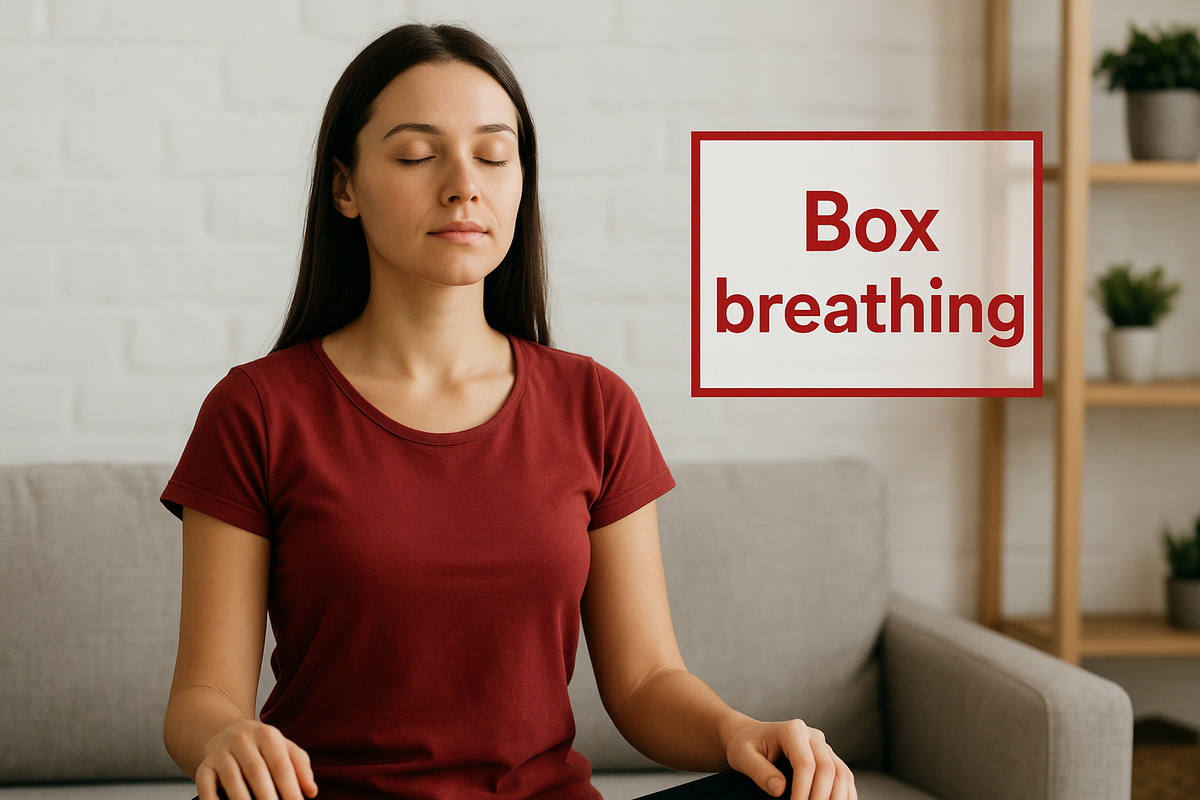
4. Box breathing

Box breathing transforms your respiratory pattern into a powerful tool for calming your nervous system during anxiety episodes. This controlled breathing method creates equal intervals for inhaling, holding, exhaling, and pausing, which signals your body to shift from fight-or-flight mode into a more relaxed state. Military personnel and first responders use this technique in high-stress situations because it works quickly and requires no equipment.

What it is

This structured breathing exercise follows a four-count pattern where each phase lasts the same duration. You inhale for four counts, hold your breath for four counts, exhale for four counts, and pause for four counts before repeating. The symmetrical timing gives your mind a specific task while regulating oxygen and carbon dioxide levels in your bloodstream, which directly influences your anxiety response.

Box breathing works as one of the most effective grounding techniques for anxiety because it gives you control over your physiological state through deliberate breath regulation.

How to do it step by step

Sit upright with your feet flat on the floor and your hands resting comfortably. Breathe in slowly through your nose for four seconds, feeling your lungs expand. Hold that breath for four seconds without straining. Exhale completely through your mouth for four seconds, emptying your lungs. Pause for four seconds before starting the next cycle. Complete at least four full rounds for maximum effect.

When to use it

Practice this method when you notice early anxiety symptoms like increased heart rate or shallow breathing. Box breathing works particularly well before stressful events, during panic attacks, or when you need to think clearly under pressure. The consistent timing helps when your thoughts feel chaotic and unfocused.

Variations and safety notes

Adjust the count to three or five seconds if four feels uncomfortable for your lung capacity. Some people prefer inhaling through the nose and exhaling through the mouth, while others use only nasal breathing. Stop immediately if you feel dizzy or lightheaded, which signals you're breathing too deeply or holding too long.

5. Progressive muscle relaxation

Progressive muscle relaxation targets the physical tension that accompanies anxiety by systematically tightening and releasing muscle groups throughout your body. This method teaches you to recognize the difference between tension and relaxation, giving you more awareness of where stress accumulates in your muscles. Many people carry anxiety in their shoulders, jaw, or stomach without realizing it until they practice this deliberate contrast.

What it is

This technique involves deliberately tensing specific muscle groups for several seconds before releasing them completely. The contrast between the tight and relaxed states helps your nervous system recognize when muscles are holding unnecessary tension. Unlike passive relaxation methods, this active approach gives your brain a clear framework for releasing physical stress that builds up during anxious periods.

Progressive muscle relaxation works as one of the most effective grounding techniques for anxiety because it addresses the physical symptoms directly rather than just focusing on your thoughts.

How to do it step by step

Start with your feet and toes, squeezing them tightly for five seconds before releasing. Move up to your calves and thighs, tensing each group individually before letting go. Continue through your stomach, chest, and back, holding tension briefly in each area. Tighten your hands into fists, then your arms and shoulders. Finally, work through your neck, jaw, and face, scrunching and releasing each section. Complete the full body scan from bottom to top.

When to use it

Use this method when anxiety creates noticeable muscle tension or when other grounding techniques haven't addressed your physical symptoms. This approach works well before bed when racing thoughts prevent sleep, or during long periods of stress when your body needs active release.

Variations and safety notes

Skip any muscle groups that cause pain or cramping rather than healthy tension. Some people prefer working top to bottom instead of bottom to top, which can feel more natural for releasing facial tension first.

6-cold-water-reset.png

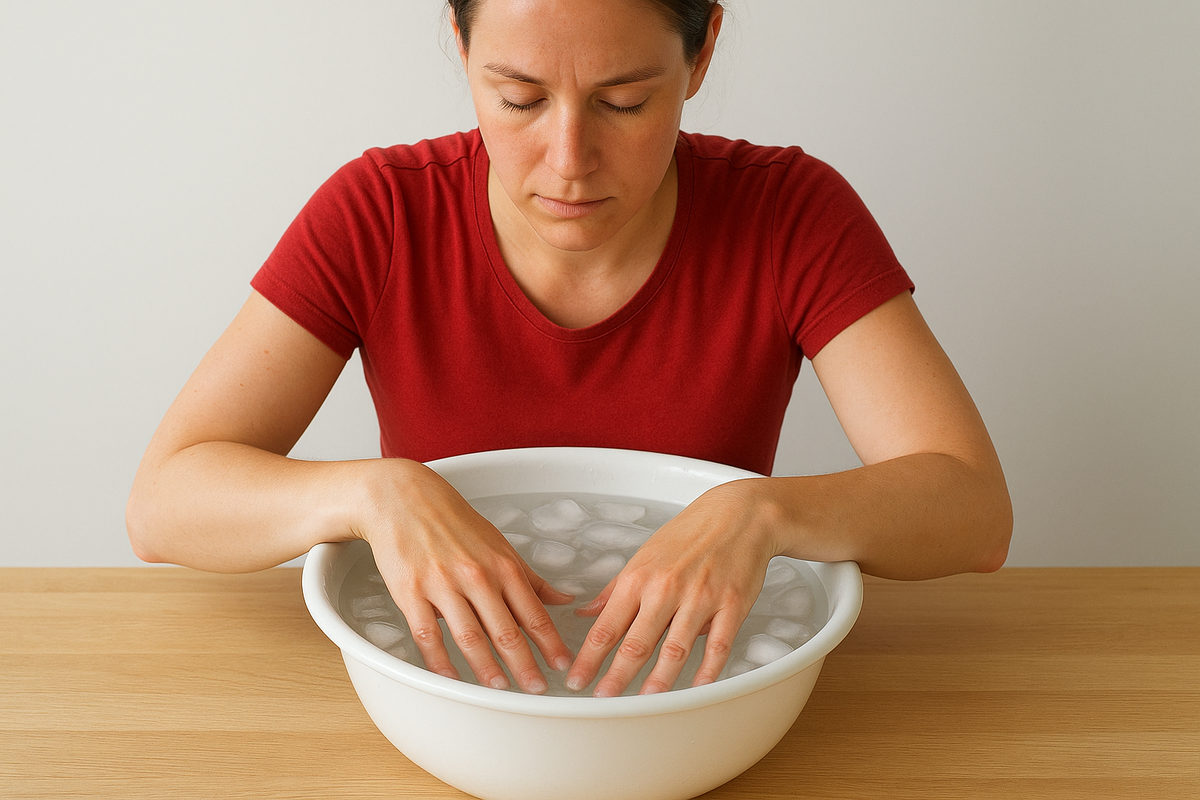
6. Cold water reset

Exposing your body to cold water triggers an immediate physiological response that interrupts anxiety's hold on your nervous system. This method activates your dive reflex, which slows your heart rate and redirects blood flow away from your extremities toward vital organs. The sudden temperature change demands your brain's attention, pulling focus away from anxious thoughts and into your physical experience.

What it is

Cold water grounding uses temperature shock to reset your nervous system during heightened anxiety or panic. You apply cold water to specific parts of your body, typically your face, wrists, or hands, which sends signals through your vagus nerve to calm your fight-or-flight response. This technique ranks among the fastest grounding techniques for anxiety because it creates an unavoidable sensory experience that your brain must process immediately.

Cold water exposure forces your nervous system to prioritize the physical sensation over anxious thoughts, creating an instant mental break.

How to do it step by step

Fill a bowl with cold water and add ice if available. Submerge your hands and wrists for 30 seconds, or splash cold water on your face repeatedly. Alternatively, hold an ice cube in each palm and focus on the sensation as it melts. Run cold water over your wrists and inner forearms for at least 15 seconds if a sink is your only option.

When to use it

Apply this method during panic attacks or when other techniques fail to reduce your symptoms. Cold water works particularly well when anxiety creates a disconnected feeling from your body or when you need immediate relief before an important event.

Variations and safety notes

Take a cold shower for a longer reset, starting with warm water and gradually decreasing the temperature. Avoid this method if you have heart conditions or Raynaud's disease without medical clearance. Stop immediately if you experience chest pain or extreme discomfort beyond the initial cold sensation.

7. Hold an object and describe it

Focusing your attention on a physical object gives your mind something concrete to examine when anxiety pulls you into abstract worry. This tactile grounding method works by engaging multiple senses simultaneously as you explore an item's properties in detail. You can use virtually anything within reach, making this one of the most accessible grounding techniques for anxiety in any environment.

What it is

This technique transforms an everyday object into a focus point for your attention by examining its physical characteristics methodically. You hold something in your hands and describe every detail you notice about its texture, temperature, weight, shape, and appearance. The detailed observation process occupies your mind with sensory input rather than anxious thoughts.

Describing an object in precise detail forces your brain to shift from emotional processing to analytical observation, which naturally reduces anxiety intensity.

How to do it step by step

Choose an object within arm's reach, such as a pen, phone, coin, or piece of fabric. Hold it in your hands and notice its weight and temperature against your skin. Run your fingers over the surface texture, identifying whether it feels smooth, rough, bumpy, or ridged. Examine the colors and patterns you see, noting any variations or details you normally overlook. Describe the shape and size either silently or aloud, using specific language.

When to use it

Use this method when you need a quick distraction from intrusive thoughts or when other techniques feel too complex. This approach works well in waiting rooms, during commutes, or any situation where you have a few minutes and something to hold.

Variations and safety notes

Carry a dedicated grounding object like a smooth stone or textured keychain for consistent use. Avoid objects with sharp edges or anything that might cause injury if you squeeze too hard during panic.

8. Name colors and shapes around you

Identifying colors and shapes in your environment creates a simple mental exercise that redirects your focus from anxious thoughts to visual observation. This method requires no special objects or preparation, just your ability to look around and categorize what you see. The straightforward nature makes it particularly useful when anxiety makes complex grounding techniques for anxiety feel overwhelming or impossible to execute.

What it is

This technique uses visual categorization to ground you in the present moment by naming colors and geometric shapes you observe in your surroundings. You systematically scan your environment and call out specific colors or shapes, either silently or aloud, which engages the analytical part of your brain rather than the emotional centers driving your anxiety.

Categorizing visual elements forces your brain to shift from emotional reactivity to logical observation, which naturally reduces anxiety intensity.

How to do it step by step

Start by choosing either colors or shapes as your focus category. If you pick colors, name five different colors you see around you, such as the blue wall, red book, or green plant. For shapes, identify five geometric forms like the rectangular door, circular clock, or triangular picture frame. Move through your environment methodically, looking left to right or top to bottom.

When to use it

Apply this method when you need a quick grounding exercise that doesn't require moving or touching anything. This approach works well in public spaces, offices, or vehicles where other techniques might seem awkward or impractical.

Variations and safety notes

Combine both categories by alternating between naming a color and a shape. Some people prefer focusing on one specific color and finding it in multiple locations throughout their environment.

9. Put thoughts into categories

Organizing your anxious thoughts into specific categories creates mental distance between you and the worries flooding your mind. This cognitive grounding method treats your thoughts like items to sort rather than truths you must believe or problems you must solve immediately. The categorization process shifts you from emotional reaction into analytical mode, which naturally reduces anxiety's grip on your thinking.

What it is

This technique involves labeling your thoughts as they arise by assigning them to predetermined categories such as "past," "future," "helpful," or "unhelpful." You observe each thought without judgment and simply place it in a mental filing system based on its characteristics. The sorting process interrupts the cycle of rumination by transforming abstract worries into concrete data points you can examine objectively.

Categorizing thoughts creates psychological distance from anxiety by treating your internal dialogue as information to organize rather than reality to accept.

How to do it step by step

Notice a thought and identify whether it concerns past events, future worries, or present circumstances. Label it accordingly in your mind or write it down. Next, determine if the thought is helpful or unhelpful for your current situation. Some people add categories like "facts versus stories" or "things I control versus things I don't control." Continue sorting each thought as it appears without trying to stop or change the thoughts themselves.

When to use it

Use this method when rumination takes over or when you struggle to separate realistic concerns from anxiety-driven catastrophizing. This approach works particularly well for people who respond better to analytical exercises than sensory-based grounding techniques for anxiety.

Variations and safety notes

Create your own category system based on what helps you most, such as "urgent versus non-urgent" or "evidence-based versus assumption-based." Some people prefer writing categories on paper to make the sorting more concrete and visible.

10. Count backward and do simple math

Engaging your analytical brain through numerical tasks interrupts the emotional processing that fuels anxiety. This cognitive grounding method works by giving your mind a specific problem to solve, which requires concentration and pulls your focus away from worried thoughts. Mental math demands enough attention that you cannot simultaneously maintain intense anxiety, making it a practical tool when other grounding techniques for anxiety feel too abstract.

What it is

This technique uses basic arithmetic or counting exercises to occupy your mind with logical tasks rather than emotional reactions. You perform simple calculations like counting backward by threes from 100 or multiplying single digits together. The mental effort required to complete these numerical challenges redirects your brain's resources from anxiety circuits to problem-solving areas.

Mathematical tasks force your brain to shift from emotional reactivity to logical processing, which naturally reduces anxiety symptoms.

How to do it step by step

Start counting backward from 100 by sevens, saying each number aloud or silently. If that feels too difficult, count backward by threes or fives instead. Alternatively, multiply single-digit numbers together in your head, such as 6 times 7, then 8 times 4. You can also add up random numbers you see around you, like combining digits on license plates or clock displays.

When to use it

Use this method when intrusive thoughts dominate your mind or when you need distraction from physical anxiety symptoms. This approach works particularly well for people who find mental challenges calming rather than stressful.

Variations and safety notes

Switch to easier calculations if the math creates additional frustration during high anxiety. Some people prefer alphabet tasks like reciting every other letter or naming words that start with each letter sequentially.

11. Use an anchoring statement

Creating a personal anchoring statement gives you a verbal tool to remind yourself of reality when anxiety distorts your perception. This linguistic grounding method uses simple declarative sentences that state facts about your current situation, which helps counter the false narratives anxiety creates in your mind. Speaking these statements aloud or silently provides an immediate reality check that you can deploy anywhere without equipment or preparation.

What it is

An anchoring statement is a predetermined phrase that connects you to the present moment and contradicts anxiety's false messages. You create sentences that state objective facts about who you are, where you are, or what is actually happening right now. These statements work as verbal reminders that your anxious thoughts represent feelings rather than reality, making them effective grounding techniques for anxiety that you can memorize and access instantly.

Anchoring statements work by replacing anxiety's distorted messages with factual observations about your current reality.

How to do it step by step

Develop three to five short statements that describe your current circumstances, such as "I am sitting in my office" or "My name is [name] and I am safe right now." Write these down and memorize them before anxiety strikes. When you feel anxious symptoms building, repeat your statements slowly, either aloud or in your mind. Focus on the literal truth of each statement rather than how you feel emotionally.

When to use it

Apply this method during panic attacks or moments when anxiety makes you feel disconnected from reality. These statements work particularly well for people who experience depersonalization or catastrophic thinking patterns.

Variations and safety notes

Some people add sensory details to their statements, like "I feel my feet on the ground." Avoid statements about the future or past, which can trigger more anxiety rather than grounding you.

12-ground-through-movement-and-stretching.png

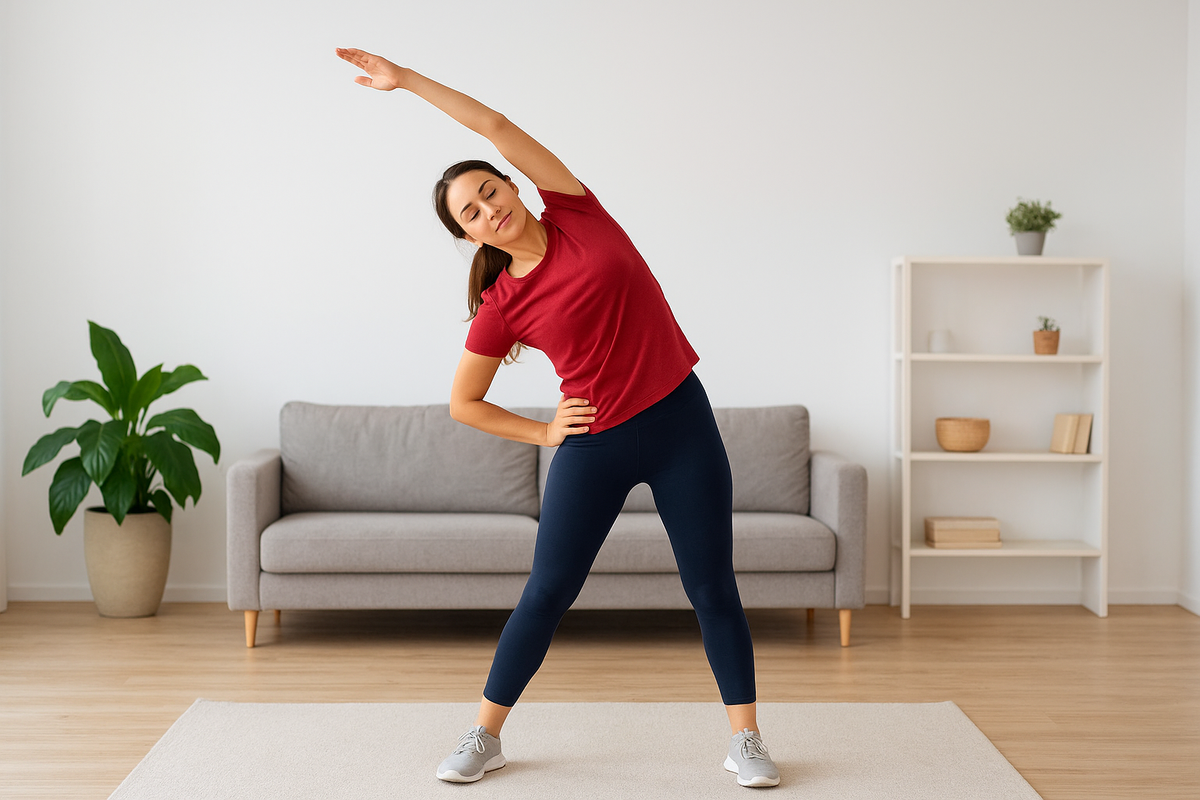
12. Ground through movement and stretching

Physical movement channels the excess energy that anxiety creates in your body by giving it a productive outlet rather than letting it build up as tension. This kinesthetic grounding method uses deliberate stretching and motion to reconnect your mind with your body when anxious thoughts make you feel disconnected or trapped inside your head. The combination of movement and breath creates a dual focus that interrupts anxiety's hold on your attention.

What it is

This technique uses intentional physical activity to discharge the adrenaline and cortisol flooding your system during anxiety episodes. You perform simple stretches, gentle movements, or basic exercises that require body awareness and coordination. The physical engagement forces your brain to process proprioceptive feedback about where your body exists in space, which naturally reduces the intensity of anxious thoughts by shifting your attention from internal worry to external action.

Movement-based grounding works by transforming anxiety's physical energy into purposeful action rather than letting it fuel more worried thoughts.

How to do it step by step

Stand up and roll your shoulders backward five times, then forward five times. Reach your arms overhead and stretch to each side, holding for five seconds. Touch your toes or reach toward the ground without straining. Shake out your hands and arms vigorously for ten seconds. Walk in place while lifting your knees high for 30 seconds. Rotate your head slowly in each direction.

When to use it

Use this method when restless energy accompanies your anxiety or when sitting still makes symptoms worse. This approach works particularly well during work breaks or when you've been sedentary for extended periods.

Variations and safety notes

Try yoga poses like child's pose or cat-cow stretches for slower, more meditative movement. Avoid intense exercise during panic attacks, as it can mimic anxiety symptoms and increase distress.

13. Repeat calming self-talk

Speaking compassionate phrases to yourself during anxiety creates an internal voice that counters the harsh, critical thoughts anxiety generates. This verbal grounding method uses carefully chosen words that you repeat deliberately to shift your mental state from panic to calm. Unlike anchoring statements that focus on facts, calming self-talk addresses your emotional experience directly with phrases designed to soothe rather than just inform.

What it is

This technique involves creating and repeating supportive phrases that acknowledge your distress while offering reassurance. You select short, affirming statements that feel natural to your speaking style and repeat them during anxious moments. These phrases work as one of the most portable grounding techniques for anxiety because they require nothing except your voice and your willingness to speak kindly to yourself.

Calming self-talk replaces anxiety's harsh internal dialogue with gentle, supportive language that helps your nervous system settle.

How to do it step by step

Choose three to five simple phrases like "This feeling will pass," "I am safe right now," or "I can handle this moment." Say your selected phrase slowly and deliberately, either aloud or in your mind. Repeat the same phrase five to ten times before moving to the next one. Focus on the meaning of the words rather than rushing through them mechanically.

When to use it

Use this method when negative self-talk intensifies your anxiety or when you need gentle reassurance during panic. This approach works particularly well at night when racing thoughts prevent sleep or during situations where you cannot use physical grounding methods.

Variations and safety notes

Record yourself saying the phrases and play them back during anxiety episodes for an external voice. Avoid phrases that feel false or patronizing, which can increase frustration rather than providing comfort.

grounding-techniques-for-anxiety-infographic.jpeg

What to do next

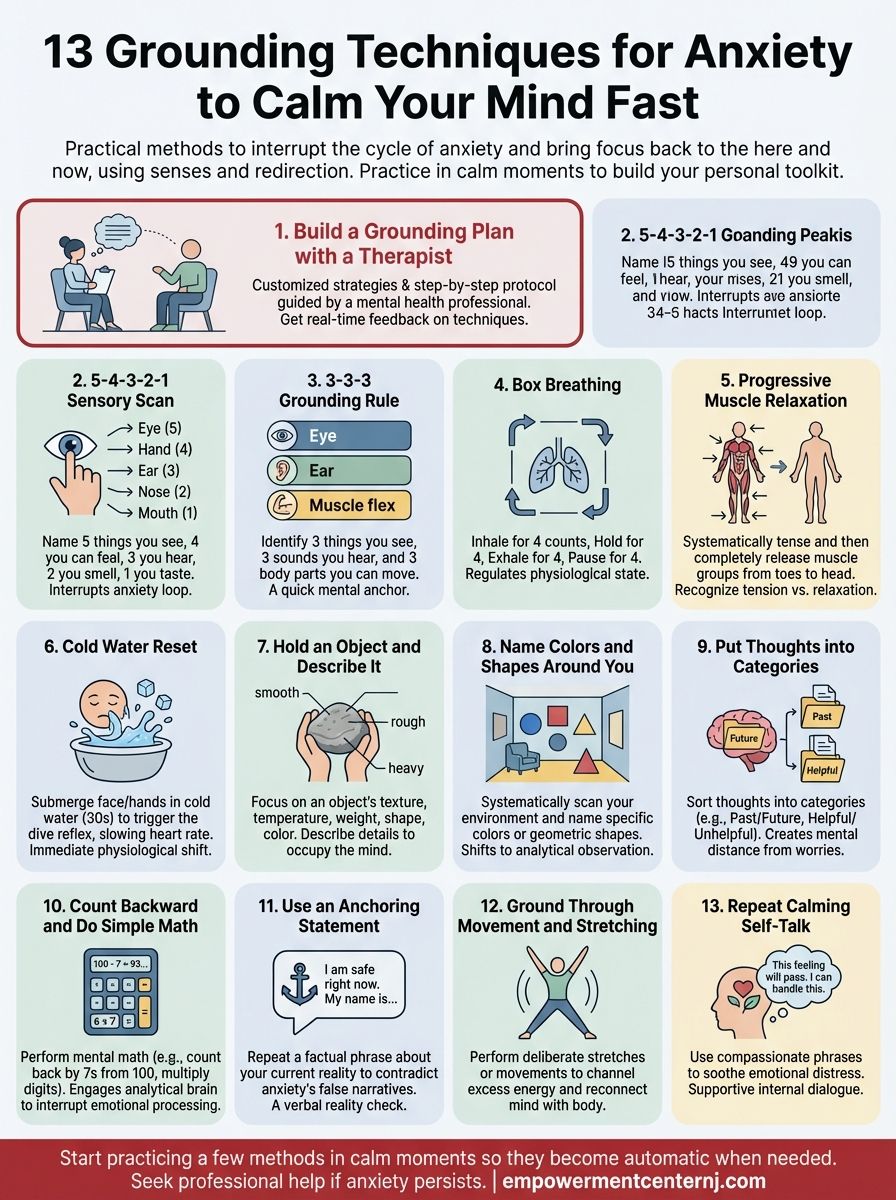
You now have 13 grounding techniques for anxiety that you can use immediately when symptoms strike. Start by practicing two or three methods during calm moments so they become automatic when you actually need them. Your brain learns these skills more effectively through repetition before crisis hits, not during it.

Keep a list of your most effective techniques where you can access them quickly. Some people screenshot their favorites on their phone, while others keep a notecard in their wallet. The key is having your personal toolkit ready when anxiety builds, not scrambling to remember what works.

If anxiety continues disrupting your daily life despite using these tools, professional support can help you identify why your symptoms persist and develop a comprehensive treatment plan. The Empowerment Center offers anxiety therapy in Monmouth County with flexible scheduling including evenings and weekends, plus telehealth options for remote sessions across New Jersey.