how-cbt-works-in-practice.png

DBT vs CBT: Key Differences, Benefits, And Who Each Helps

You've heard both terms thrown around, maybe by a friend, a doctor, or during your own research, but when it comes to DBT vs CBT, the differences aren't always clear. Both are evidence-based therapies that help people manage difficult emotions and change unhelpful patterns. Yet they work in distinct ways, and choosing the right one can make a real difference in your progress.

Cognitive Behavioral Therapy focuses on identifying and restructuring negative thought patterns, while Dialectical Behavior Therapy adds mindfulness and emotional regulation skills to the mix. Understanding which approach fits your specific struggles, whether that's anxiety, depression, intense emotions, or relationship difficulties, can help you feel more confident walking into your first session. It's not about one being "better" than the other; it's about finding the right fit for you.

At the Empowerment Center, we use CBT as a core part of our therapeutic approach, helping clients in Monmouth County and throughout New Jersey take an active role in their mental health. This guide breaks down how each therapy works, what conditions they treat best, and how to determine which path aligns with your goals.

Why the difference matters

You might assume that all therapy is basically the same, but the distinction between DBT and CBT directly affects what you'll learn, how you'll practice those skills, and whether you'll see the progress you're hoping for. Mismatched therapy can leave you feeling frustrated or stuck, not because therapy doesn't work, but because the approach doesn't align with what you're actually dealing with. Knowing which one fits your needs saves you time, energy, and the discouragement that comes from trying something that wasn't designed for your specific situation.

Different tools for different struggles

CBT gives you structured techniques to challenge negative thoughts and break cycles of anxiety or depression. If you find yourself catastrophizing, ruminating on past events, or avoiding situations because of feared outcomes, CBT offers direct solutions to rewire those patterns. You'll work through exercises that help you test your assumptions and build evidence against the distorted thinking that keeps you stuck.

DBT, on the other hand, was built for people who experience intense emotional swings that feel overwhelming and uncontrollable. If your emotions escalate quickly, if you struggle with self-destructive behaviors, or if relationships repeatedly end in conflict, DBT teaches emotional regulation and distress tolerance that CBT doesn't emphasize. It assumes that your emotions are valid but need better management, not just cognitive correction.

Choosing the wrong approach can delay your progress, while the right fit helps you build skills that actually address what's happening in your daily life.

Impact on your treatment experience

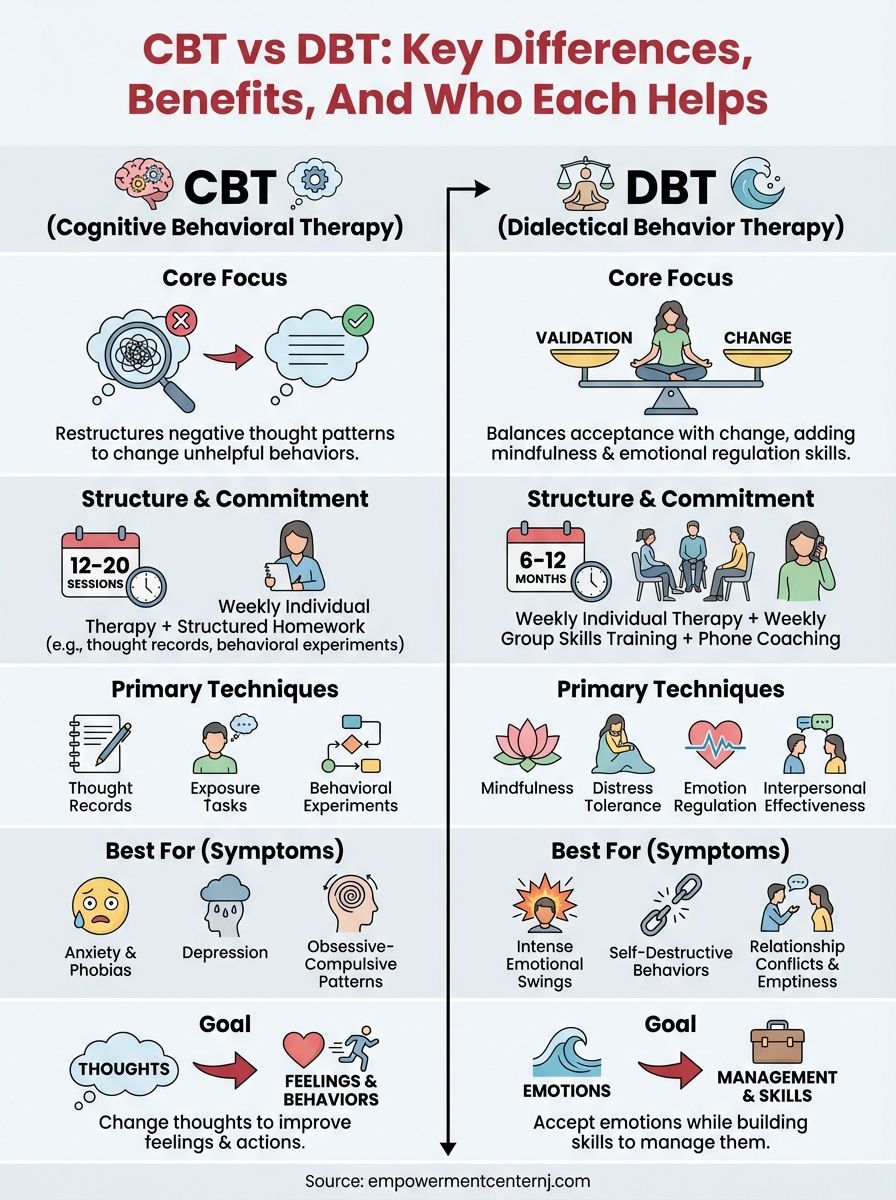
The structure of each therapy shapes how you spend your time in and outside of sessions. CBT typically runs shorter, maybe 12 to 20 sessions, with focused homework between meetings. You'll practice thought records, behavioral experiments, and exposure tasks that target specific symptoms. This works well if you have a clear problem to solve and prefer a direct, time-limited approach.

DBT requires a longer commitment and often includes group skills training alongside individual therapy. You'll learn mindfulness, interpersonal effectiveness, emotion regulation, and distress tolerance through weekly practice. The intensity and duration make sense when you're dealing with chronic emotional instability or patterns that have persisted for years. Understanding the dbt vs cbt difference helps you set realistic expectations about what you'll be asked to do and how long you'll need to commit.


How CBT works in practice

Your therapist starts by helping you identify specific problems you want to solve, whether that's panic attacks, social anxiety, or persistent low mood. Each session focuses on connecting your thoughts to your feelings and behaviors, showing you how negative thinking patterns drive the symptoms you experience. You'll learn to catch automatic thoughts as they happen, question their accuracy, and replace them with more balanced perspectives that reduce emotional distress.

The session structure

Sessions typically follow a predictable format that includes reviewing homework, setting an agenda, working through current challenges, and assigning new practice tasks. Your therapist might ask you to describe a recent situation that triggered anxiety or depression, then walk you through the cognitive model to see how your interpretation created your emotional response. This isn't just talking about your week; you're actively learning techniques like thought records, behavioral experiments, and exposure hierarchies that target your symptoms.

The collaborative nature means you set the goals, and your therapist teaches you the skills to reach them. If you're avoiding situations because of fear, you'll gradually face those situations while practicing new coping strategies. The emphasis on measurable progress keeps you focused on what's actually changing rather than just feeling heard.

Between-session work

CBT assigns structured homework that reinforces what you learned in session. You might track your mood daily, complete thought records when you notice negative thinking, or practice relaxation exercises before anxiety-provoking situations. This work outside the office determines how quickly you improve, since the goal is building skills you can use independently.

The more consistently you practice between sessions, the faster you'll see symptoms decrease and confidence increase.

When comparing dbt vs cbt, this emphasis on cognitive restructuring and time-limited treatment defines CBT's approach to change.

How DBT works in practice

DBT begins with a comprehensive assessment where your therapist evaluates emotional intensity, relationship patterns, and any self-destructive behaviors that interfere with your life. You'll commit to individual therapy sessions (usually weekly) plus a separate skills training group that meets for two to three hours each week. This dual format ensures you get both personal attention and structured learning alongside others facing similar challenges. The therapy assumes your emotions are valid responses to real pain, but you need better strategies to manage them without making situations worse.

The foundational approach

Your therapist balances validation with change, acknowledging your struggles while teaching you new ways to respond. Sessions alternate between problem-solving current crises and building skills across four core modules: mindfulness, distress tolerance, emotion regulation, and interpersonal effectiveness. When you're in crisis, your therapist helps you use these skills immediately rather than waiting for the crisis to pass. Phone coaching between sessions gives you real-time support when you need it most, a feature that distinguishes DBT from most other therapies.

The combination of validation and skill-building creates a balance that helps you feel understood while still moving toward change.

Skills you'll practice

Group sessions teach specific techniques you can use when emotions escalate. You'll practice mindfulness exercises to stay present, distress tolerance skills like self-soothing and radical acceptance, emotion regulation strategies to reduce vulnerability to intense moods, and interpersonal effectiveness tactics for setting boundaries without damaging relationships. Homework involves daily diary cards tracking your emotions, behaviors, and skill use. This detailed tracking helps you and your therapist identify patterns and measure progress. Understanding dbt vs cbt highlights how DBT's comprehensive skill set addresses emotional dysregulation in ways cognitive restructuring alone cannot.

key-differences-at-a-glance.png

Key differences at a glance

When you compare dbt vs cbt side by side, the contrasts become clear in their focus, structure, and what they ask you to do. CBT targets thought patterns that drive symptoms, while DBT addresses emotional dysregulation through comprehensive skill-building. Understanding these distinctions helps you recognize which therapy matches your actual needs rather than guessing based on general descriptions.

Structure and time commitment

CBT typically runs 12 to 20 sessions with weekly individual meetings focused on specific symptoms. You'll spend most of your time working on cognitive restructuring and behavioral experiments with homework between sessions. The shorter timeline works well when you have a clear problem to address and want measurable progress within a few months.

DBT requires a longer commitment, often six months to a year, with both weekly individual therapy and a separate group skills training session. The dual format means you're investing four to five hours weekly between individual sessions, group meetings, and homework. This intensive structure makes sense when emotional instability affects multiple areas of your life and quick fixes haven't worked.

Primary techniques

CBT teaches you to identify automatic thoughts, test their accuracy through behavioral experiments, and replace distorted thinking with balanced perspectives. Your therapist helps you see how thoughts create feelings, then gives you specific tools to interrupt that cycle.

DBT assumes your emotions are valid but need better management strategies, not just cognitive correction.

DBT emphasizes mindfulness and acceptance alongside change strategies, teaching you to tolerate distress without making it worse, regulate emotions before they escalate, and navigate relationships effectively. The balance between validation and skill-building distinguishes DBT's approach from CBT's focus on thought restructuring.

How to choose between DBT and CBT

Start by looking at what's actually happening in your daily life rather than picking therapy based on what sounds more appealing. If your thoughts spiral into worst-case scenarios, if you avoid situations because of anxiety, or if depression keeps you stuck in negative thinking patterns, CBT gives you direct tools to challenge those patterns. You'll work on restructuring thoughts and testing beliefs through behavioral experiments that target specific symptoms.

Assess your symptoms

Your emotional experience tells you which approach fits better. Choose CBT when your symptoms include persistent anxiety, panic attacks, depression with negative thought loops, specific phobias, or obsessive-compulsive patterns. These conditions respond well to cognitive restructuring and behavioral interventions that change how you interpret situations.

If your emotions escalate quickly and feel uncontrollable, or if you struggle with self-destructive behaviors and intense relationship conflicts, DBT offers the emotional regulation skills you need.

Consider DBT when you experience emotional intensity that disrupts your life, impulsive behaviors you regret later, chronic feelings of emptiness, or repeated relationship breakdowns. The skills training addresses emotional dysregulation in ways that cognitive work alone cannot.

Consider your availability

CBT requires weekly individual sessions and homework practice, typically wrapping up in three to five months. This works if you need focused treatment that fits into a standard work schedule without major time disruptions.

DBT demands more intensive commitment with both individual therapy and group skills training each week, often lasting six months to a year. You'll invest four to five hours weekly between sessions and practice. Understanding dbt vs cbt helps you choose based on what you can realistically maintain rather than what sounds easier upfront.

dbt-vs-cbt-infographic.jpeg

Your next step

Understanding dbt vs cbt gives you the clarity to make an informed decision about your mental health treatment. You now know that CBT works best for thought-driven symptoms like anxiety and depression, while DBT addresses emotional dysregulation and intense relationship patterns. The right choice depends on your specific struggles, your availability for intensive treatment, and whether you need cognitive restructuring or comprehensive emotional skills.

You don't have to navigate this decision alone. At the Empowerment Center, we use CBT as our core approach to help clients throughout Monmouth County and New Jersey build confidence and take control of their mental health. If you're ready to address negative thought patterns, develop practical coping strategies, or work through anxiety and depression, our flexible scheduling and telehealth options make it easier to get started. Reach out today to discuss your specific needs and determine the best path forward for your situation.