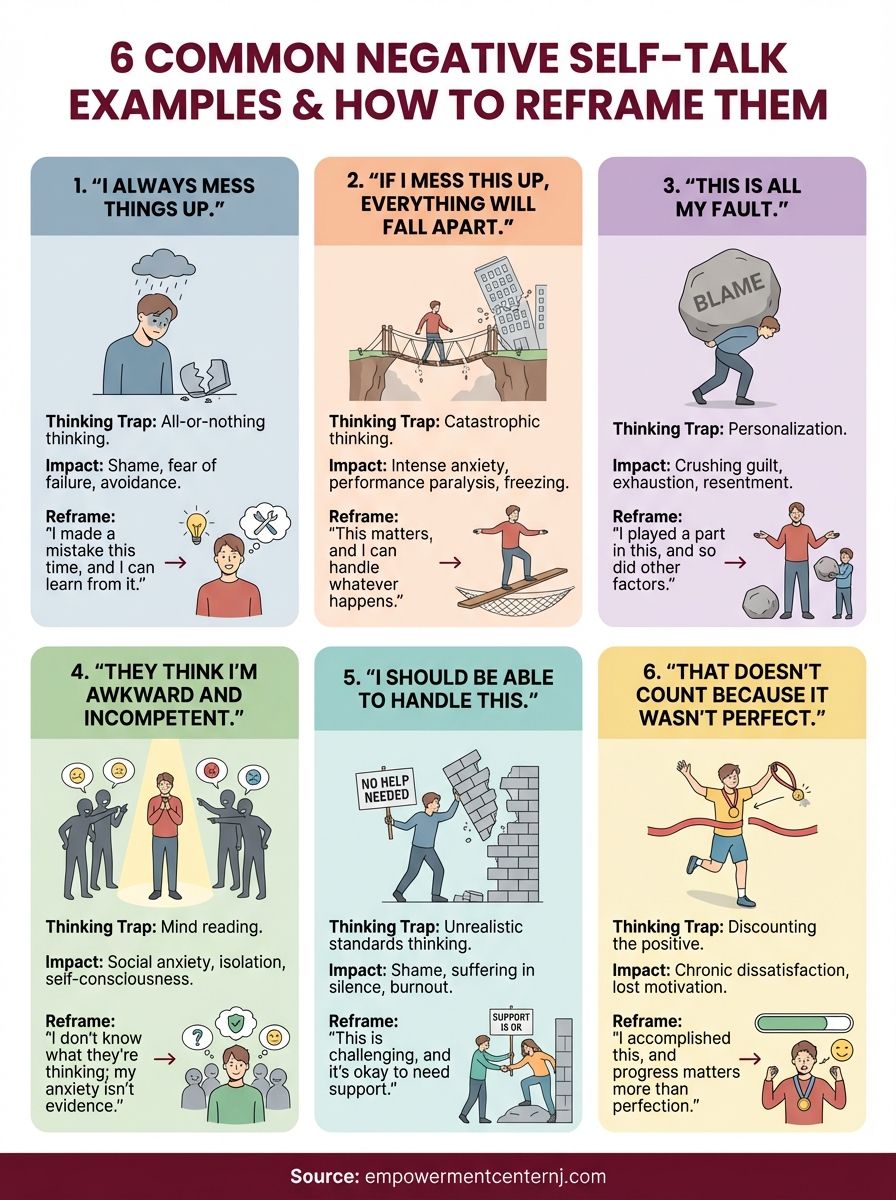
This sweeping statement ranks among the most damaging negative self talk examples you'll encounter. When you catch yourself thinking or saying this phrase, you're collapsing every mistake into a permanent character flaw. The word "always" transforms a single error into proof of lifelong incompetence.
What it sounds like in real life
You might hear this voice after forgetting a deadline at work, burning dinner, or saying something awkward in conversation. The thought typically arrives within seconds of the mistake: "Of course I did that. I always mess things up." Sometimes you'll add specifics like "I always forget important things" or "I always say the wrong thing." Your brain treats one mishap as evidence of an unchangeable pattern.
What thinking trap hides underneath
This pattern is called all-or-nothing thinking, also known as black-and-white thinking. You're ignoring every neutral or positive outcome and focusing exclusively on failures. Psychologists recognize this as a cognitive distortion that distorts reality by erasing nuance and context from your self-assessment.
When you think in absolutes like "always" and "never," you're building a case against yourself using incomplete evidence.
How it affects your mood and choices
This thought pattern triggers shame and hopelessness almost immediately. You stop seeing mistakes as temporary setbacks and start viewing them as proof of inadequacy. Over time, you avoid new challenges because "what's the point if I always mess up anyway?" This creates a self-fulfilling cycle where fear of failure prevents you from practicing and improving.
A balanced reframe to try
Replace "I always mess things up" with "I made a mistake this time, and I can learn from it." This reframe acknowledges the error without making it permanent. You could also try "I've handled many situations well, and this one didn't go as planned." Both versions keep the mistake in context.
A quick practice for the next 24 hours
Catch yourself using "always" or "never" statements about your abilities. When you notice one, immediately list three times you handled a similar situation differently. Write them down if possible. This exercise trains your brain to recognize evidence it typically ignores.